

Aleš Vodopivec in his home library, Ljubljana, September 2025. Photo: Robert Potokar.
Editorial / Piranesi 52/53
Where are we, and where are we going?
I try to avoid political topics in my editorials, but given the current global situation, it is simply impossible to refrain from personal commentary, even if I limit myself to just two contradictory topics – the high-tech development of the 21st century on the one hand, and the primitive principles of the previous centuries on the other, on the basis of which statesmen try to shape the image of the world in accordance with egotistic principles of governance and the conquest of territories through a policy of force, threats and irrational wars. It is truly inconceivable how silent we have become in the face of this, how we close our eyes and, despite all the horrors, are unable to condemn the Israeli genocide that is taking place every day in Gaza. Something that is unimaginable in today’s world, where digital developments are now moving faster than we can keep up with. This allows us to get answers and explanations about anything in a millisecond with just one click or a conversation with ChatGPT, and artificial intelligence performs tasks for us that were unimaginable just a short time ago. Technological progress is so rapid that humanity can barely keep up. The world has become distinctly bipolar: one part focused on a bright future, the other lost in the dark of the past.
We live our own lives in such a world, trying to distance ourselves, at least in our minds, from global problems, and focusing instead on ourselves and our daily tasks, so that the unease in our hearts and minds does not poison us too much, so that we can function “normally” in our seclusion as much as possible. And perhaps it is precisely because of all this that we still persist in our faith and hope for a better world, a world that will be worthy of living in, regardless of gender, religion or ethnicity, and consequently we also persist in the print edition of Piranesi magazine, because we believe that the magazine, originally published for the Piran Days of Architecture, still fulfils its mission by highlighting quality architecture, well-designed spaces and the people who create them. This is our small contribution to a semblance of normality.
This issue features an interview with Professor Aleš Vodopivec, who has been contributing to Slovenian architecture for many years. An architect, thinker, teacher and critic, he is also an excellent conversationalist who uses his moral stance to hold up a mirror to spatial and architectural policy in Slovenia, which is why his critical thinking is not to everyone’s liking. However, it is good to have individuals in society who know how to do this, are able to think differently, and who open up other perspectives on pressing issues, as we ourselves too often fail to speak up. Several architectural works in Slovenia were built according to Vodopivec’s plans, including the Srebrniče Cemetery, the central theme of this issue, a special space of remembrance embedded in nature, where the burial grounds are set amid forest glades, and where relatives and visitors can say goodbye to their loved ones in peace. It is an outstanding landscape and architectural project in every respect: in terms of its conceptual and urban planning, the architectural and symbolic aspects, right down to the smallest detail. And now, 25 years later, when the design has truly become part of the landscape, the experience of this peaceful place is a real balm for the soul.
On the subject of cemeteries, in the theoretical part of this issue we are also publishing an article by the landscape architect Tanja Simonič Korošak on the Navje Cemetery in Ljubljana, a lesser-known work by the architect Jože Plečnik, which was transformed from a cemetery into a memorial park after the Second World War and is still awaiting renovation in the spirit of Plečnik. Incidentally, Plečnik’s parents, Andrej and Helena Plečnik, are buried in Navje. And this year, a modern cemetery with a clear conceptual idea was completed on the Slovenian coast above Ankaran, where the grounds offer a view of the sea horizon. It is the work of the younger architects of the Void office and the landscape architects of the AKKA studio – who, with their minimalist architectural language, have succeeded in creating a high-quality work in material terms for Slovenian conditions, with the visible concrete finished to perfection – and has earned several professional awards.
Another theoretical contribution to this issue relates to the architecture of remembrance, and this is a text by Vladimir Šlapeta, who tells the story of the creation of the tomb of the Czech kings at Hradčany. The tomb was designed in the 1930s by Kamil Roškot, an interesting architect of the generation that put Czech modern architecture of the 1930s on the world architectural map. This was a period when the young state of Czechoslovakia also reached the peak of its political, economic and industrial development. We write about this in our review of a book on Czech modern architecture, in which the same author, Vladimir Šlapeta, provides a chronological overview of the development of Czech modern architecture from 1900 to the present day. The work is truly groundbreaking, and we have been waiting for it for quite some years. However, his selection does not include the pedestrian bridge over the Vltava River in Prague, which is presented in this issue of Piranesi, although it deserves to be included for its simple elegance, as the minimalist white line spans the river and splits into two parts, with a slight curve where it meets the right bank.
Slovenian architecture is represented by several projects, including the new, architecturally outstanding DARS business building in Ljubljana by the architects of Abiro and a villa on the Prekmurje plain, in the suburbs of Murska Sobota, by the architect Tomaž Ebenšpanger. The villa, designed in a modernist architectural style and reminiscent of the architect Feri Novak, reflects the principle of a pavilion-like placement of the building in nature, on a green carpet, where a sliding wall emerges from the basic concrete volume and directly connects the interior space with nature. The wall becomes a movable frame that frames the idea of the disappearing boundary between inside and outside, while also being the main recognisable element of the architecture. Last year’s Piranesi Award went to Vidic Grohar arhitekti for the design of the temporary premises of the Slovenian National Theatre (SNT) Drama. The premises of SNT Drama in the centre of Ljubljana, located in a 19th-century building, were scheduled for renovation, and a temporary solution had to be found until the work is completed. With minimal intervention but carefully considered details and materials, the architects repurposed the premises of the former Litostroj industrial complex so that SNT Drama could move from its existing premises to new, temporary ones in just over a year. How long the theatre company will be at its new home will only become clear in the coming years.
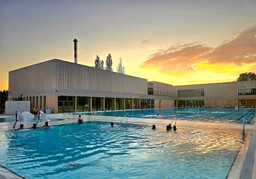
Another Slovenian project worth mentioning here is the Vevče swimming pool complex in Ljubljana, designed by Gužič Trplan arhitekti. Opened this year, the wooden structure impresses users with its purity, calmness and connection to the nearby Ljubljanica River in terms of the principles of sustainable construction, inviting us to join the swimmers for a late afternoon dip when the warm sunlight blends with the pleasant warmth of the wood.

Thematically different, but similar in design and construction, is the pavilion with grandstands in neighbouring Carinthia, Austria, where the architects Hohengasser Wirnsberger have once again demonstrated that all their projects are well thought out and, where possible, made of wood, and Austrian wood at that. Wood is a common theme in all European countries, not only those where it is abundant, but also in some where, until recently, it was not used much. Take Spain, for example, which has recently joined the trend of using more wood in architecture. At this year’s Venice Architecture Biennale, it was the Spanish pavilion that most clearly presented several different architectural projects made of wood and brick. And as a pavilion, it was perhaps the one that best matched the title theme of the event: Intelligens. Natural. Artificial. Collective. It was essentially a multi-faceted theme and, in connection with artificial intelligence, encompasses various disciplines, from art, engineering, biology, science, technology, social and political sciences, to sustainable planning. And we can only hope that this is the direction in which we are all heading.


Slovenia
House on the Edge of the Plain, Murska Sobota

Croatia
Interiors by AKSL arhitekti

Hungary
Family Home, Transformation of a 100-year-old fruit storage building, Szentendre


