

Photo: Alex Shoots Buildings
New Architecture / Piranesi 52/53
The Štvanice Footbridge in Prague
Atelier Bridge Structures + Blank architekti
A White Line Over the River
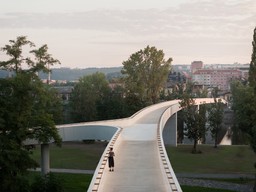
In photographs, the new bridge across the Vltava in Prague looks like a thin white line in the urban landscape. But it is much more than a beautiful work of architecture: it is also an innovative work of engineering and an important part of the city’s public space.
The bridge for pedestrians and cyclists crosses the Vltava at a place where the river’s artificial regulation ends and its natural shorelines hint that we are leaving the city center. It connects the neighborhoods of Holešovice and Karlín, two former industrial suburbs which today are experiencing a postindustrial boom that is transforming them into popular residential and office districts. Nevertheless, gentrification has so far not displaced all of the neighborhoods’ original residents and the creative individuals and groups that have found a refuge here. The northeastern edge of Prague’s historic core is today a vibrant part of the city whose vitality is in no small part thanks to the area’s social mix.

But what draws people here is not just the pulsating urban life; it is also its exact opposite: nature in the form of the river and the “urban wilderness” that has remained on its banks after the departure of the local factories and port facilities. And lying in the middle of the river between Holešovice and Karlín is Štvanice Island. Although the island has traditionally been home to recreational and sporting facilities, its eastern end was long neglected and difficult to reach. The first plans for a bridge date to the early twentieth century, but it wasn’t until the year 2000 that a competition was held for a bridge design, which was won by a team headed by leading Czech architect Alena Šrámková. Two years later, Prague was struck by a thousand-year flood, with Karlín and Holešovice among the worst-hit areas, and so plans for the bridge’s construction were abandoned. In 2017, an international architectural competition was held for a “bridge for pedestrians and bicyclists that will connect the banks of Karlín, Holešovice, and Štvanice Island. The proposed design should promote connections between the municipal districts – a goal of city-wide importance – while also providing access to Štvanice Island.”[1] The winning design by architects Petr Tej and Marek Blank, done in collaboration with engineer Jan Mourek, was built (with minor alterations) in the years 2021–2023.

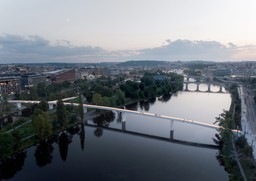
The design team proposed a concrete structure with load-bearing parapets that spans the river in a gentle curve measuring just under 300 meters in length, with an 80-meter-long ramp leading down to the island from one side of the bridge. The bridge deck sits atop two supports on the riverbanks, two on Štvanice Island, and just two piers in the broader, non-navigable arm of the Vltava. The footbridge thus makes an unusually subtle first impression. Like natural paths through the landscape, it curves both horizontally and vertically on its journey across the river. As a result, when you move along the bridge you don’t see the other end right away but instead see the bend in the path. In my view, this “minor detail” turns the act of moving along the bridge into an exceptional experience: you feel like you are traveling over water, your gaze drawn to look out over the river instead of staring ahead at your destination on the other side.
To read the whole article, please order the copy of the magazine HERE.
[1] https://www.cka.cz/souteze/databaze/lavka-holesovice-karlin. Accessed 22 September 2025.
Project Data
The Štvanice footbridge in Prague, Prague, Czech Republic
Architecture
Atelier Bridge Structures + Blank architekti: Petr Tej (architect and bridge engineer), Marek Blank (architect), Jan Mourek (bridge engineer), Aleš Hvízdal (sculptor), Jan Hendrych (sculptor)
Client
The City of Prague: Petr Hankovec
Project year
2017-2022
Completion year
2023
Span
300 m between Holešovice and Karlín, ramp to Štvanice island 80 m Alex Shoots Buildings
Costs
300 M CZK


Slovenia
House on the Edge of the Plain, Murska Sobota

Croatia
Interiors by AKSL arhitekti

Hungary
Family Home, Transformation of a 100-year-old fruit storage building, Szentendre


