

Photo: Miran Kambič, 2001
Architectural Icon / Piranesi 52/53
Srebrniče Cemetery, Novo Mesto, Slovenia, 2000
Aleš Vodopivec, Nena Gabrovec, Davorin Gazvoda, Dušan Ogrin
Between the courtyard and the forest: Srebrniče Cemetery as the site of new tradition
Midway upon the journey of our life
I found myself within a forest dark, […][1]
In the late summer afternoon sun, when we can already sense the approaching autumn ripeness, the edge of the forest on one of the busiest roads leading into Novo Mesto thins out, and pools of light appear between the tall trees, breaking through the darkness of the undergrowth. The sliver of light appearing at the forest’s edge is the only sign visible from afar of the Srebrniče municipal cemetery, which was opened a quarter of a century ago. If visitors walk the three kilometres from the city to the cemetery, they are not treated to an immersive stroll through the hilly Dolenjska region, but to all the noise of the growing suburbs with their shopping centres, heavy lorries and, so it seems, cars that are simply allowed to exceed the speed limit. Srebrniče is primarily very noisy, until it becomes very quiet. Instead of a traditional cemetery with a clearly defined wall, the entrance here is inconspicuous, and the perimeter is a zone of gradual changes in light, shade and sound, which slowly introduce us to the experiential landscape. The noise from the main road never completely dies away, but the undulating terrain, tree trunks and crowns of the karst forest of Dolenjska cover it well enough that the rumbling soon turns into a barely perceptible murmur of the present but distant society.
One enters a traditional cemetery, but in Srebrniče, one finds oneself in it. The threshold of the traditional cemetery is on the edge and marks a clearly defined boundary between two worlds. The threshold in Srebrniče, however, is in the middle, when we only gradually realise that we have left one world and entered another. The funeral hall deep in the middle of the cemetery is the central framework for experiencing the space, which is designed as a path through changing environments. Srebrniče is a space that is not designed for viewing, but for movement and experiencing change; time is the measure of a cemetery visit, whether we measure it by the half-hour ceremony between the funeral hall and the grave, a day-long meditation of the changing light in the sunlit clearings and shady patches of the forest, or the experience of eternity, which cemeteries can never really escape.

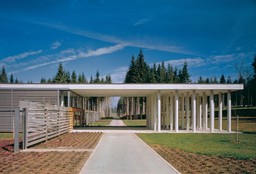
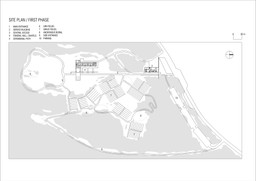
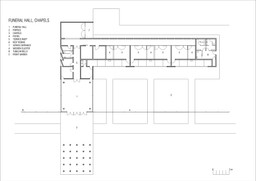
Srebrniče is designed around two basic, clearly legible gestures that define two spatial experiences in a few strokes: architectural, which, with the straight line of the central avenue and the two perpendicular roofs of the central funeral hall, symbolises the initiation from an ascetic-functional entrance to the expressive centre of the collective part; and the landscape, which, with meandering paths and a soft transition from less to more dense wooded areas of the cemetery, creates smaller, enclosed burial zones. The clear, straight line of the collective ritual branches off from the funeral hall, loosens up and turns towards the somewhat dark, inviting edge of the forest, along which smaller clearings with graves are located.

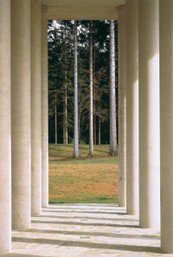
Srebrniče can be read as a spatial framework for experiencing contemporary, pluralistically open mourning, but the space is equally meaningful as a landscape and architectural meditation on the relationship between Nature and Man. The success of Srebrniče is largely the result of an understanding that contemporary design means defining what needs to be done and also taking a stance towards everything that does not need to be done. The design of a path through the space in which people intensely relive the stages of life and death could too easily become a didactic allegory with overly verbose architectural and landscape interventions. However, Srebrniče never becomes an allegory, an architectural and landscape spatialisation of a preconceived story, but instead builds an open infrastructure of remembrance in restrained submission to the landscape and its basic characteristics of light, shadow, smells and sounds. The creative language of the cemetery’s authors was a conscious opening up to what already existed. I believe that in the 21st century, saturated with human activity, materialism and the marketing of novelty, this is precisely why Srebrniče is ageing so well.

The forest as a cultural space
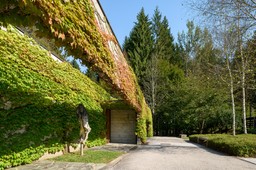
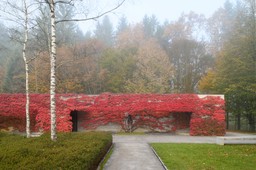
Srebrniče is a cultural landscape where the forest does not offer refuge from society, but rather an extension of society into the forest. The culturalisation of the forest has a longer history in Slovenia than it might seem at first glance. For Slovenia, which boasts the largest proportion of forest area in Europe after the Scandinavian countries, the forest is a matter of identity and historical experience that is so deeply rooted today that it is easy to forget how new it is. Old photographs of Slovenian landscapes (except for the less accessible pre-Alpine hills) are much barer than today’s intensely green tourist postcards. As in many other Central European societies, the forest was a matter of class stratification, manifested through the ritual of hunting, to which only aristocratic landowners had the right. What ended up in the hands of farmers after the abolition of serfdom was quickly depleted, and the game was hunted to extinction.

To read the whole article, please order the copy of the magazine HERE.
[1] Dante Alighieri, Canto I, The Divine Comedy, translated from the Italian by Henry Wadsworth Longfellow, now in the public domain.
Project Data
Srebrniče Cemetery, Novo Mesto, Slovenia
Architecture
Aleš Vodopivec, Nena Gabrovec
Landscape architecture
Dušan Ogrin, Davorin Gazvoda


Slovenia
Ljubljana Castle, Ljubljana, Slovenia – Renovation

Slovenia
Ljubljana Castle, Ljubljana, Slovenia – History

Slovenia
Edvard Ravnikar: The Modern Gallery, Ljubljana, Slovenia, 1948


