

Photo: Jure Živković
New Architecture / Piranesi 52/53
Production and Business Facility Dubrovčan, Dubrovčan
MVA / Mikelić Vreš arhitekti
Dialogue with Space and Tradition
The genius loci of the Croatian Zagorje is not a thing that belongs to the past, but a living element that could be reinterpreted.
Architecture is, perhaps more than any other form of artistic and technical creation, inseparable from the space and time in which it occurs. Since the 18th century, when the term genius loci – spirit of a place – emerged in architectural theory, it has become a fundamental category through which we contemplate the relationship between architecture and context. Architecture not only provides a response to functional needs, but also a means of interpreting landscape, history, culture, tradition, materiality and lifestyle. In this context, space cannot solely be understood as a physical framework, but as a layered structure of meaning arising from collective memory and individual experience.

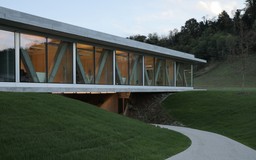
Christian Norberg-Schulz, in his book Towards a Phenomenology of Architecture (1980), points out that architecture should give concrete expression to the meaning of a place and articulate its existential dimension. Space, according to him, is not a neutral scene, but an active participant in human existence: it includes memory, emotion and sensory experience. Architecture thus becomes a means of reading and deepening the meaning of space – a bridge between the natural and cultural, between the past and present.

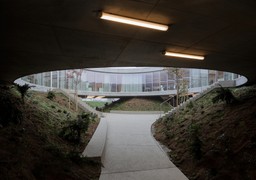
In the modern context, especially in the era of globalization, this idea is gaining prominence again. The wide availability of information and global market pressures have produced an architecture that is often universal, generic and devoid of local identity. Rem Koolhaas argued in his provocative essay “Bigness” (S,M,L,XL, 1995) that large-scale architecture no longer has to be part of the urban fabric: “It exists; at most, it coexists. Its subtext is fuck context.” This radical stance opens the following question: Can architecture be universal and relevant at the same time? In the global age, can we rediscover the spirit of place and reinterpret it in contemporary spatial practices?
To read the whole article, please order the copy of the magazine HERE.
Project Data
Production and Business Facility Dubrovčan, Dubrovčan
Architecture
MVA / Mikelić Vreš arhitekti
Project team
Marin Mikelić, Tomislav Vreš, Mia Kos, Fran Stanić
Collaborators
Barbara Horvatić, Anita Kovačić, Maja Pijaca, Marin Ševo
Client
MDK Građevinar
Year of design
2019 – 2021
Year of completion
2024
Area
1.850 m²


