

Photo: Simone Bossi
Piranesi Awards / Piranesi 52/53
Piranesi Mention 2025: Piazza Cortevecchia, Ferrara, Italy
INOUT architettura
A piazza on the move. Above, below, and across the public space.
A continuous, three-dimensional parcel creates a new topography in the Old Town of Ferrara. A single architectural element whose design condenses and makes inseparable the space of the piazza, the space for the trees, and the room available for crossings and impromptu uses[1].
In a historical moment marked by accelerated changes, architecture can no longer be a rigid entity but must be able to transform itself, in terms of adaptability and resilience, without losing its identity and its connection to the specific characteristics of the relevant context. The new Piazza Cortevecchia in Ferrara, designed by INOUT Architettura, is an example of how to use an architectural project to describe the rediscovery of a place deeply linked to the city, in addition to the generative reasons behind a public space adapted to demands dictated by the climate crisis and the extempore uses of urban life.

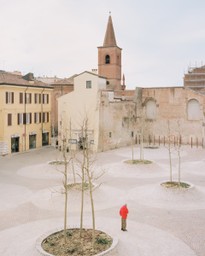
Back in the 16th century, Piazza Cortevecchia, in Ferrara’s Old Town, housed the auditorium of the Theatre of Alfonso II d’Este. After numerous alterations, it became a fish market in the 1930s, but in the ’60s this latter building was also demolished. This piazza has always been a place of intense footfall because of its position near the Cathedral and the Piazza del Municipio [City Hall Square, t/n], and is linked directly to the nearby Piazza Trento and Trieste by Via Cortevecchia. However, until 2024, it remained an unresolved parcel of land, divided up into fragments devoid of any connection. One portion was occupied by stalls of commercial activities, another given over to parking, instead, in the background – hugging the beautiful wall of the Parish Church of Santo Stefano – sat some waste bins.
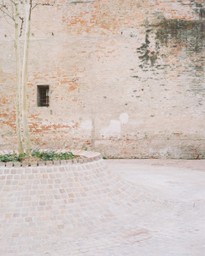
In 2024, INOUT Architettura’s entry was selected as the winner of a public competition held by the Municipality of Ferrara as part of an experimental programme of interventions aimed at increasing the resilience of urban sub-systems liable to climate change risks. The project is based on the wish to combine two apparently irreconcilable conditions with an architectural gesture of synthesis without subordination, namely, placing tall trees in a location not geared to accommodate them. On the one hand, therefore, the architects took into account the climatic context (the progressive increase in temperatures with heatwaves, droughts, decrease in annual rainfall, sudden intense meteoric events) which recognizes trees, with their foliage and projected shade, as the most effective tool to reduce these extreme conditions. On the other, a reading of the context and morphology of Ferrara’s Old Town highlighted the need to restore to the place its vocation as a piazza, in the traditional sense – that is, an undivided urban void – paved over, and available to the community at large. In addition, the presence of underground utilities and traces of ancient buildings in the subsoil – the latter to be preserved without needing to be brought to the surface – made it particularly difficult to locate any kind of plant due to the limited room for a root system.
To read the whole article, please order the copy of the magazine HERE.
[1] The content of this article comes from an interview held in September 2025 with Mario Assisi and Valentina Milani, the owners of the INOUT Architettura firm.
Project Data
Piazza Cortevecchia, Ferrara, Italy
Architecture
INOUT architettura
Project team
Comune di Ferrara (Ing. Olga Mantovani)
Design phase
September 2022 – June 2023
Construction phase
September 2023 – June 2024
Project area
2.600 mq
Construction cost
800.000€
Hydraulic engineer
Ing. David Voltan
Agronomist
Dott. Agr. Giovanni Morelli
Contractor
Arredo Urbano s.r.l, 39100 Bolzano (BZ)
Sub contractor
Tedioli arboricoltura


Slovenia
Piranesi Award 2025: Temporary premises of the Slovene National Theatre Drama Ljubljana, Slovenia

Slovenia
Piranesi Award 2022: Covering the remains of the Church of St. John the Baptist in the Žiče Charterhouse and the temporary lapidary

Slovenia
Piranesi Mention 2021: Ptuj Marketplace


