

Photo: Mateja Jordovič Potočnik.
Interview / Piranesi 52/53
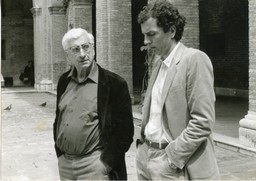
Interview with Aleš Vodopivec
For a human-scale, tailored space
by Robert Potokar
The title theme of this issue of Piranesi is the Srebrniče Cemetery, a work that represents the most important contribution to the culture of commemoration of the deceased at the turn of the millennium in Slovenia. With the hindsight of twenty-five years after its creation, it is presented in more detail in a separate article, so this interview sheds light on several other things that have defined your relationship to architecture and culture, although in the questions that follow I shall inevitably return to this outstanding project.
The architect Aleš Vodopivec, born in 1949, has not only left an undeniable mark on architecture, but has also been a professor at the Ljubljana School of Architecture who has taught many students who are now co-creating the image of Slovenia’s space. As an author, he highlighted the importance of Professor Edvard Ravnikar in his works, he has also been a member of many competition juries, but above all he is a thinker who has turned a critical eye towards the current society, urban planning and architecture. In addition to all of the above, he has won several first prizes in competitions and received many prestigious Slovenian and European awards for architecture.

Studies
Piranesi: Aleš, we’ve known each other for a long time, since the 1980s, when I started working as a student with Vojteh Ravnikar. You and Vojteh were friends, colleagues, collaborators in the ab magazine, the Architect’s Bulletin, and if I’m not mistaken it was you who managed to convince Vojteh to complete his studies and to finally – he was already in his thirties – graduate.
As a student, I also helped Vojteh with competition projects from time to time, when I was still a complete beginner. It was my first experience outside school. It was completely different from what I had imagined working in an architectural office would be. The atmosphere was relaxed, friendly, fun, and the socialising occasionally turned into a night of partying. Vojteh had already had some notable successes in competitions in the Yugoslav space, but he was already quite resigned to the fact that he would not finish his studies, because he had not yet passed Professor Lapajne’s exam in building mechanics. After a little persuasion, I introduced him to a colleague who, with a few tuition sessions, finally got him to pass this exam and then to graduate.
My friendship with Vojteh, the trips to the Karst and the travels together in Italy and Greece were my initiation into architecture, much stronger than the first years of my studies. Vojteh loved architecture with all his heart and knew how to pass on his enthusiasm to others. This was also evident later when he became a professor at our school.
I would like to ask you a few more questions about your studies. How did you decide to study architecture, you did not formally enrol until 1969. Before that, you were first enrolled in civil engineering, and later on, with Jurij Kobe, your path took you to the Faculty of Arts to study philosophy, which gave you an additional breadth of thought, not only about architecture, but also in the perception of life as such.
The decision to study architecture was more the result of a combination of circumstances than of a strong desire. After graduating from high school I was undecided, thinking about studying mathematics, psychology or architecture. To this day, I still don’t know why I initially enrolled to study civil engineering. But already in my first year I experienced a kind of a shock. From the culturally really exciting environment of the high school on Šubičeva Street, I ended up in a technically bland world that was completely alien to me. So, after my first year, I enrolled in architecture, too, and soon realised that this environment was closer to my interests.
The decision to study philosophy was probably influenced by my home environment, and later by Professor Pirjevec’s lectures at the Faculty of Arts, which at the time were strongly influenced by Heidegger and phenomenology. And of course Professor Ravnikar with his intellectual breadth. On one occasion he even wrote that a true architect must also be a philosopher. Jurij and I abandoned the study of philosophy after the second year, but I’m convinced that the basics of philosophy were extremely useful and incomparably more important for architectural thought than many compulsory subjects at our school.
There are probably many events from your time as a student, is there one that is particularly interesting? After all, these were the late 1960s and early 1970s, when the student movement around the world was progressive, avant-garde and wanted to change the world.
What I remember more than individual events is the general optimism. And the belief among young people that we ourselves can change the world into a better place. It was probably the last time we believed in a future based not just on the individual’s material prosperity, but on social solidarity. Hence the revolutionary enthusiasm. This resulted in the student riots and is echoed by the appearance of Room 25 in our school. I think Ravnikar saw it as an opportunity for the school to change even after the failed attempt to reform the studies with the “B strand” – in the sense of an “experimental anti-university”, as he put it. At that time, typewriters started to appear on drawing tables, and for a few years his students would also publish the AA journal. An alternative to regular study was also encouraged by the students of his seminar, and Ravnikar supported their initiatives despite the opposition of the school’s management.
If I’ve read correctly, you weren’t an actual member, but you were involved in the activities in Room 25 at the faculty, you took part in actions, workshops, critiques, and so on.
I was two years their junior, but I hung out mainly with Vinko Torkar, Dare Poženel and Bojana Klemenčič. We worked together on a project to use empty attics for youth housing, and I took part in protest actions and in the creation of the AA journal.
You graduated in 1974 with a theoretical thesis on the architecture of Ljubljana under Professor Edvard Ravnikar. It can be seen as the first architectural guide to the city, which was published as a special edition of the ab magazine.
Already during my studies I had been both drawing and writing. Ravnikar noticed this and suggested that I prepare a guide to the architecture of Ljubljana for my graduate thesis. In other words, not to graduate with a project.
Together with Peter Gabrijelčič, you participated with Professor Ravnikar in some competitions at the federal Yugoslav level. How did that collaboration work?
How can you have a collaboration between someone who is a complete greenhorn and a man who was one of the central figures, if not the most prominent of all, in Yugoslav architecture at that time? I never presumed that I was anything more than a draughtsman at that time. Ravnikar was not only a man of exceptional intellectual breadth, as in the circle of those close to him he could also be very direct and witty in a human way. Knowing that Peter brought me into that circle, I am still grateful to him for that experience.
In several interviews you have pointed out that you consider yourself lucky for having your path cross with that of Professor Ravnikar. During your studies and afterwards, you and he maintained a special relationship. Can you tell us more about it?
I probably experienced him very differently from his many colleagues in the office, who were under the constant pressure of deadlines, investors and contractors, which Ravnikar himself also found difficult to tolerate. As I said, during my studies I only worked with him on competitions and some conceptual designs. Towards the end of my studies, when he parted ways with his assistants, Peter and I also helped him with his lectures. In the evenings, when it was often just Ravnikar, Bitenc and me at the school, we would open a bottle of wine together. Ravnikar and I became even closer at these gatherings.
After finishing my studies, we went out to dinner at a suburban inn quite regularly, maybe once a month. It was only on rare occasions that we spoke about architecture. We talked more about culture, art, politics, and so on. Undoubtedly, these encounters have shaped not only my professional career, but also my view of the world.
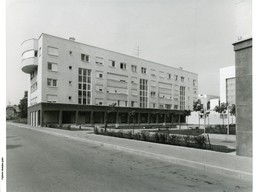
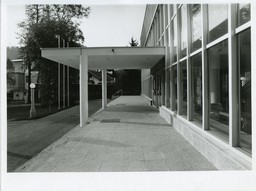
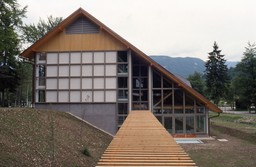
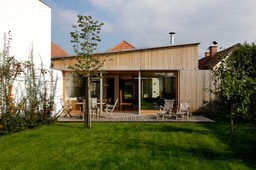
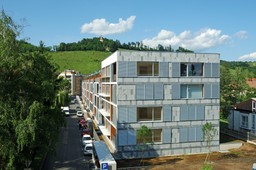
After graduating, your path led you to work as a freelance architect, not to a job in a state architectural office. Soon after you started, you and Jurij Kobe designed several buildings, some of which have been sadly erased from memory: the municipal building in Novo Mesto, the Barje bus stop on the Ljubljana ring road, the petrol station in Tržič. Some of your independent and truly remarkable buildings, however, have survived and now complete the picture of Slovenian architecture.
Both Jurij and I made our first projects without any serious design experience that one gets from working in an architectural office. I am self-critical enough to say that I never saw our early works as major achievements of Slovenian architecture. In that sense, I am not sorry that some of them no longer exist. As I have said many times, I am convinced that far too much is built in the developed world. Without the many new constructions, this world would be a kinder place, because it is only exceptionally that constructions have a positive impact on people’s quality of life. I think that this is becoming increasingly evident in Ljubljana, too.






You never had an independent practice, you worked formally through Arche, which brought together independent architects. You were assisted on projects by various collaborators, including Nena Gabrovec and later Gašper Medvešek. Didn’t you wish for your own office?
As a freelance architect, I worked with several colleagues and friends, but always in a small group. During my work as an architect, I was also constantly drawn to the field of theory and writing. In that sense, I never really wanted a bigger office. On the contrary, when I started lecturing, initially for the Landscape Architecture course, I soon noticed that I would find it difficult to keep up with the demands of responsibility towards a project, and in times of crisis, even more difficult to keep up with the demands for decent remuneration for my colleagues.
I found most personal satisfaction in lecturing at the School of Architecture. At the same time, I was paid for this work with a full-time salary from public funds, and even an allowance for extra work. I therefore saw my duties at the school as my primary duty and responsibility.

On Writing and the Critical View
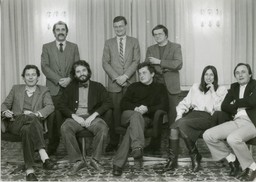
You were on the editorial board of the Architect’s Bulletin, ab. I could devote half an interview to this, but in short: ab was a groundbreaking, critical magazine in those years, a reflection of a new mentality, and it also introduced special chapters on architectural theory, which had been mostly absent in Slovenian magazines. Stane Bernik’s Sinteza [Synthesis] was different, it published the latest architectural projects of the time, while you at ab wanted to critically point out many of the anomalies that were happening in space and society.
At that time, the prevailing opinion in this country, especially among art historians, was that architects should draw and others should write about architecture. Plečnik also thought so. Ravnikar did the opposite, he was constantly writing in addition to designing. Like Le Corbusier. I read recently that Le Corbusier had Homme de Lettres written next to his name on his personal card. He obviously wanted to emphasise that he was not only an architect, but a man of words, an intellectual. Which is absolutely true also of Ravnikar.
We started to edit ab shortly after finishing our studies, unencumbered professionally, without any serious design experience. That’s why we were perhaps too critical at times. However, at regular weekly meetings, which usually continued late into the night at the Pen Club, we worked out common or at least related theoretical starting points through discussions. Probably these meetings were even more important for us than the publication of the journal.

Being involved in ab inspired you to write books later on. One of the first was, together with Janez Koželj, From Architecture, and your part is entitled “Questions on the Art of Building”. In it, you defined architectural elements and parts, and placed them in a historical overview. For us students at that time, the book helped us to realise that what we were taught at the faculty was not the only way to do things, but that there was a lot more to it.
My text was influenced by criticisms of modernist architecture, which eventually became a canon of style while losing its revolutionary and social mission. In this sense, it seemed necessary to look back to the past, to the origins, in order to find a way forward.
My part of the book was actually written as an independent contribution to a larger research task of the Institute of Urban Planning. I was invited to participate by Braco Mušič. It was probably Janez’s idea to combine the two texts, which were written completely independently, in a joint book.
A special part of your journalistic work is the book publications on Ravnikar. A collection of his essays entitled Art and Architecture, edited jointly with the architect Rok Žnidaršič, and the book Edvard Ravnikar, Architect and Teacher, published by Springer Verlag. A few years ago, you wrote a professional piece for Piranesi on the Ferantov Garden, one of the most important pieces of residential architecture in Slovenia. Do you want to shed more light on Professor Ravnikar’s work, thinking and contribution to Slovenian culture, and not only with regard to architecture, by revealing and writing about him through your research?
Yes, in recent years I have written several texts and given many lectures on Ravnikar and his work. As I said, he had a significant influence on me, so I respond to every invitation related to him and his work. And every time I prepare something new and research his legacy, I also discover something new for myself. With all that he did in the field of construction, writing and lecturing, it’s quite understandable that he has a central place in Slovenian architecture. He’s undoubtedly the person who is most responsible for making Slovenian architecture better known in the 1960s, when he and a group of his most prominent graduates – Stanko Kristl, Savin Sever, Oton Jugovec, Milan Mihelič, Janez Lajovic, Grega Košak, Miloš Bonča, etc. – created a remarkable oeuvre marked by a distinctive branch of modernism, adapted to our conditions, which is now recognised worldwide.
And last but not least, whenever we write and speak about others, and we take positions, we also explain our own vision and understanding of architecture to ourselves and others.
To read the whole article, please order the copy of the magazine HERE.


Austria
Interview with Boris Podrecca

Russia
Interview with Janez Kobe

Slovenia
Interview with Janez Lajovic


