

Kamil Roškot (29 April 1886, Vlašim – 12 July 1945, Paris) with a bust made by Otakar Španiel for his fiftieth birthday, 1936
Uncategorized / Piranesi 52/53
Architect Kamil Roškot and the Royal Tomb in Prague’s Cathedral
In 1934, shortly after the death of Kamil Hilbert, who had been in charge of the completion of St. Vitus Cathedral in Prague, work on the royal tomb in the cathedral’s crypt was entrusted to the architect Kamil Roškot. Roškot took an original, modern approach to this task, creating an intimate yet monumental space that perfectly complemented Josip Plečnik’s grand renovations at Prague Castle in the cathedral’s immediate vicinity.


Plečnik viewed the first months in the newly established Czechoslovak Republic with a significant dose of skepticism. “Domestic developments do not promise much… If we must drink the cup of bitterness down to the dregs, then let us not be afraid of the last drop,” he wrote to his close friend Jan Kotěra on 1 January 1920, reflecting on the secularization of society and the radical turn away from the prewar situation, one outcome of which had been fierce public criticism of Kotěra and his peers.[1] It was clear that the “atmosphere of religiosity, the fervent Catholic enthusiasm for gloomy chapels and dark niches, and the devotion to mysticism and the typographical beauty of Latin”[2] in which Plečnik’s students had been raised was now being replaced by a new spirit, an adoration of American mechanical civilization, German New Objectivity, and the French and Soviet avant-garde. Sepulchral architecture and other monumental themes, which had previously dominated Plečnik’s teaching, were diminishing in importance.

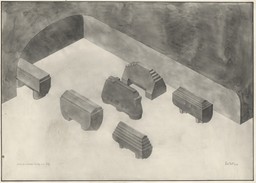
The era’s new spirit similarly dominated Kotěra’s School of Architecture, which was located on the top floor of his villa in Prague-Vinohrady in the immediate vicinity of Plečnik’s home. The school’s drafting tables were now occupied by a generation of students who for the most part were burdened by bitter wartime experiences and who were drawn to the idea of the house as a machine for living, to standardization, constructivism, and the new urbanism.
One student differed from the others, however, “A philosopher has joined us,” Kotěra is said to have proclaimed in introducing the new student Kamil Roškot (1886–1945). Roškot was different in almost every way: in age, outlook, and family background. He was nearly a decade older than his classmates, and he hailed from the respected family of the notary Antonín Roškot in Vlašim, who was also an excellent draftsman. Kamil Roškot had a bachelor’s degree in architecture from the German technical school, had taken courses in philosophy at Charles University, and had attended private painting lessons given by Max Švabinský. He spoke six languages, including classical Greek. And he had spent nearly the entire war on the Russian front. His mother Alexandra was the sister of the later president Emil Hácha, who under the old regime had been a member of the Royal and Imperial Supreme Administrate Court in Vienna, where Roškot often visited his uncle before the war. Roškot had also traveled in England, the Netherlands, Italy, and northern Africa. Thanks to these experiences, he immediately became a natural authority among his younger classmates and their unofficial spokesman. He graduated from the academy in 1922 – at age 36! – and just two years later was made a member of the prominent Mánes Association of Fine Artists. In 1928, he headed the newly founded Association of Academic Architects, an organization of architects who had graduated from art academies, and he remained in this function until his death.[3]


Above all, however, he could rightfully hold this office thanks to his body of work, in which he had managed to recast the traditional principles of architecture into a succinct, modern visual language characterized by a mastery of composition, a sense for the monumental, and a sensitive gradation of scale that produced buildings which resonated with their urban context. At the competition for a National Gallery on Prague’s Kampa Island in the fall of 1923, he won third place with a serene, elongated horizontal design that acted as a kind of pedestal for the panorama of Hradčany. Roškot’s plans so impressed the Belgian architect Henry van de Velde that he sought him out at his studio and praised his talent in La Cité magazine.[4] Roškot subsequently won awards in competitions for the Liberation Monument in Prague-Žižkov and a building for the Accident Insurance Company, a cash prize in the competition for Jirásek Bridge, third place in the competition for a parliament building on Letná Plain (1928), and first place in a site design competition for the new parliament building (1929), which he placed in the St. Peter’s Quarter. He also enjoyed success in a prestigious international competition for the Columbus Lighthouse in Santo Domingo (1928). In the 1930s, Roškot produced a number of important designs (sanatoria in Slovakia, Prague-Ruzyně airport, a theater in Tehran, a market hall in Prague-Maniny, a second building for Legiobanka), but his grand visions failed to win over the potential clients, and so they remained only on paper.
Kamil Roškot was far removed from the communist tendencies of the Left Front and its leading theorist Karel Teige, who simply ignored him. On the other hand, he acted as a link between the two generations of Kotěra’s students – the prewar generation of Cubists as represented by Josef Gočár and Pavel Janák, and the postwar Functionalist generation headed by his younger classmates Jaromír Krejcar and Bohuslav Fuchs. All along, however, he retained his admiration for his teacher Jan Kotěra as well as a sense of respect for his friend Josip Plečnik, who was a frequent guest at Kotěra’s home and studio.
Roškot’s two most beautiful projects were realized in part thanks to the support and goodwill of Plečnik’s friend Josef Cibulka, a priest and professor of liturgical art at Charles University’s Theological Faculty.[5] Cibulka first promoted Roškot as architect in 1930, for the design of a theater in his hometown of Ústí nad Orlicí, which was opened in 1936. Here, into a steep slope beneath the local church, Roškot placed the curving volume of the vestibule and auditorium, attached to which is the tholobate of the fly tower. The lateral elevations of this significantly sculptural building are lined by elegant horizontal galleries. With this theater, Roškot built the first of his masterpieces.
To read the whole article, please order the copy of the magazine HERE.
[1] Archives of the National Technical Museum in Prague, fonds Jan Kotěra.
[2] Josef Štěpánek, “Josef Plečnik, učitel a mistr,” in Architektura 4 (1942): 57–61.
[3] To date, the most extensive overview of Kamil Roškot’s work was published in Italy: František M. Černý and Vladimír Šlapeta, “Kamil Roškot, l’opera architettonica,” in Lotus International, no. 20 (1978): 63–95.
[4] Henry van de Velde, “L’architecture en Tchécoslovaquie,” in La Cité 5, no. 1 (1924): 1–9.
[5] Professor Josef Cibulka (1888–1968) was also a member of the jury for the 1919 competition for the Church of the Most Sacred Heart of Our Lord in Prague-Vinohrady (built by Josip Plečnik) and the 1928 competition for the St. Wenceslaus Church in Prague-Vršovice, which was designed by Josef Gočár.


Slovenia
House on the Edge of the Plain, Murska Sobota

Croatia
Interiors by AKSL arhitekti

Hungary
Family Home, Transformation of a 100-year-old fruit storage building, Szentendre


